An AI robot is more than a machine with a human-like shape. For global buyers, it can act as a digital sourcing assistant, research analyst, and communication tool. It can scan product specifications, compare supplier quotations, and translate technical questions within seconds. During a supplier search, it may flag missing certificates, unusual price differences, or unclear delivery terms. A buyer working from a warehouse in Germany could review three factory offers before the morning meeting. Another buyer in Brazil might use it to clarify packaging details with an overseas manufacturer.
The real value lies in better decisions, not impressive demonstrations. An AI robot can organize large amounts of market information, but it cannot guarantee product quality or supplier honesty. Not magic. Its recommendations may reflect incomplete data, language errors, or hidden commercial bias. Buyers still need samples, verified business records, written contracts, and independent inspections. Data protection also deserves attention when confidential designs or pricing information enter an AI system. A reliable approach combines automation with experienced human judgment. This guide explores what an AI robot can realistically do for global buyers, where it saves time, and where caution remains necessary. It also considers practical limits, because fast answers are not always accurate answers. The technology is promising, yet its usefulness depends on transparent data, careful verification, and responsible implementation.
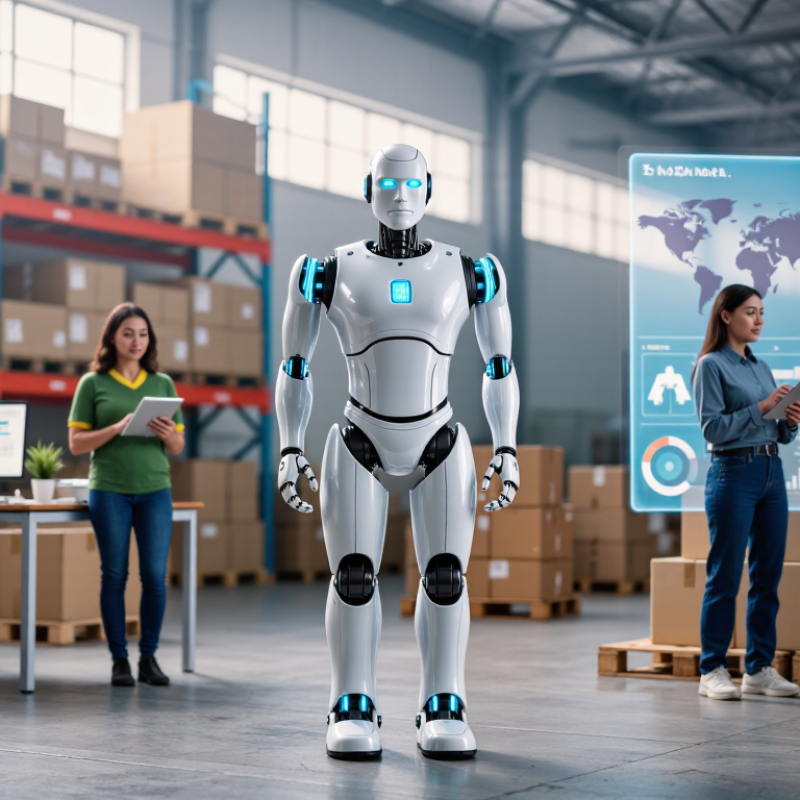
What Is an AI Robot? Definition, Core Components, and Main Types
What Is an AI Robot and How Can It Help Global Buyers?
An AI robot combines physical machinery with software that senses, decides, and acts. A traditional machine repeats programmed movements. An AI robot can adjust when objects, people, or conditions change. Its core components include cameras, force sensors, actuators, onboard computing, AI models, and safety controls. Connectivity adds remote monitoring, language support, and data exchange. However, connected does not always mean intelligent.
The main types serve different buying needs. Industrial robots handle welding, assembly, packaging, and pallet movement. Collaborative robots work beside people, usually with speed and force limits. Mobile robots navigate warehouses, factories, or hospitals. Service robots assist with delivery, cleaning, inspection, or customer interaction. Humanoid systems remain an emerging category, with uncertain productivity claims. The International Federation of Robotics reported 541,302 industrial robot installations worldwide in 2023. That figure shows strong adoption, but it does not prove every deployment uses advanced AI. Buyers should separate marketing language from measurable capability.
Tips: Ask for accuracy, cycle time, uptime, safety certification, training requirements, and total ownership cost. Request a live test using your actual products. Check performance under poor lighting, crowded floors, and changing package sizes. The AI Index 2024 reported dramatic reductions in AI inference costs, yet integration expenses can still dominate a project. Start with one narrow workflow. Measure errors before expanding. My practical concern is simple: a robot may look intelligent during a demonstration, then struggle with ordinary variation. Reliable purchasing depends on evidence, operator feedback, and honest limits.
How AI Robots Perceive Their Surroundings and Make Decisions
What Is an AI Robot and How Can It Help Global Buyers?
AI robots use cameras, depth sensors, microphones, and touch detectors to understand nearby objects. They convert these signals into a changing map of their environment. A warehouse robot may notice a pallet, a narrow aisle, or a person crossing its route. Its software then compares the scene with stored patterns and safety rules.
Decision-making happens continuously. The robot estimates distance, movement, and possible risks before selecting an action. It may slow down, stop, change direction, or request human assistance. In practical purchasing tests, buyers should observe how the robot reacts to poor lighting, reflective surfaces, noise, and unexpected obstacles. These conditions reveal more than a polished demonstration. Sensors can still misunderstand a transparent panel or a crowded work area. That limitation needs honest attention.
Tips: Ask suppliers for test data from similar workplaces. Check detection accuracy, response time, maintenance needs, and human override options. Request a live trial with real packaging, uneven floors, and normal staff movement. Keep records of false alarms and missed objects. Small errors matter.
The best evaluation also considers local operating conditions. Temperature, floor design, network reliability, and worker training can affect performance. A robot may appear intelligent in a controlled room but behave less consistently during daily operations. Buyers should review software updates, data handling practices, and safety documentation before making a decision. Reliability is built through repeated testing, not impressive claims.
What Is an AI Robot and How Can It Help Global Buyers?
AI robots combine multiple sensing technologies to understand their surroundings and make decisions. The chart compares typical effective detection ranges for commonly used robotic sensors.
Typical engineering ranges vary with hardware quality, lighting, weather, surface materials, and operating conditions. Global buyers can use this comparison to match sensor capabilities with warehouse, inspection, delivery, or navigation requirements.
Key Applications of AI Robots in Global Buying and Supply Chains
What Is an AI Robot and How Can It Help Global Buyers?
AI robots are becoming practical tools in global buying and supply chains. The International Federation of Robotics reported 541,302 industrial robots installed worldwide in 2023. Many now support warehouse movement, picking, counting, and visual inspection. These tasks reduce manual errors around cartons, pallets, and serial numbers. They also give buyers faster inventory visibility across distant facilities.
AI robots can connect physical activity with purchasing decisions. A mobile robot may detect low stock during a warehouse scan. An AI system can then compare demand, supplier lead times, and delivery records. Computer vision can check packaging damage before goods leave a facility. The World Economic Forum reported that 81% of surveyed organizations expected AI and information-processing technologies to transform business by 2027. However, forecasts can be wrong. A robot may misread reflective packaging or unusual products. Human review remains necessary for exceptions, supplier disputes, and quality failures.
Tips: Start with one measurable workflow, such as cycle counting. Track accuracy, response time, and maintenance costs. Keep audit logs for every automated recommendation. Test different lighting, languages, and product sizes before expanding globally. Data quality matters more than impressive hardware. That lesson is easy to overlook.
Benefits, Limitations, and Future Developments of AI Robots for Buyers
AI robots combine physical movement, sensors, software, and machine learning. For global buyers, they can inspect cartons, move inventory, translate instructions, and flag supply delays. The International Federation of Robotics reported 541,302 industrial robots were installed worldwide in 2023. This scale shows strong operational demand, not science fiction.
The benefits are practical. Robots can repeat quality checks without fatigue and record each action for audits. AI systems can also compare supplier data across languages and time zones. Stanford’s AI Index 2024 found that the cost of using GPT-3.5-level models fell more than 280-fold between November 2022 and October 2023. Lower costs may make intelligent purchasing assistants more accessible to smaller importers.
But limitations remain. Sensors can fail in poor lighting, crowded warehouses, or unstable network conditions. A robot may count boxes correctly but misunderstand a local packaging rule. Integration with old procurement software can be expensive. Human review is still necessary for safety, contracts, product claims, and sensitive data. The World Economic Forum’s Future of Jobs Report 2023 estimates that 23% of jobs may change by 2027, reminding buyers that automation affects people, not only processes. Future robots may learn through simulation, operate more safely at the edge, and explain decisions more clearly. I would still test them slowly. A fast machine can repeat a bad decision faster.
Conclusion
An AI robot is a machine that combines sensors, software, data processing, and physical or digital actions to understand its environment and complete tasks with limited human guidance. Depending on its design, it may operate in warehouses, factories, offices, or online purchasing systems. By collecting information through cameras, scanners, microphones, and other sensors, an AI robot can identify objects, interpret conditions, compare alternatives, and make decisions according to preset goals and changing circumstances.
For global buyers and supply chains, AI robots can simplify product searches by analyzing specifications, prices, availability, and supplier information. They can also support quality checks by detecting visible defects, measuring products, and comparing results with agreed standards. In logistics, they help track inventory, organize storage, prepare orders, and improve delivery coordination. These technologies may increase efficiency, accuracy, transparency, and response speed, but they still face limitations involving data quality, cost, system integration, safety, and human oversight. Future developments are likely to make AI robots more adaptable, collaborative, and useful while keeping responsible supervision essential.